Ductless Mini-Split Installation Cost in Tallahassee, Florida

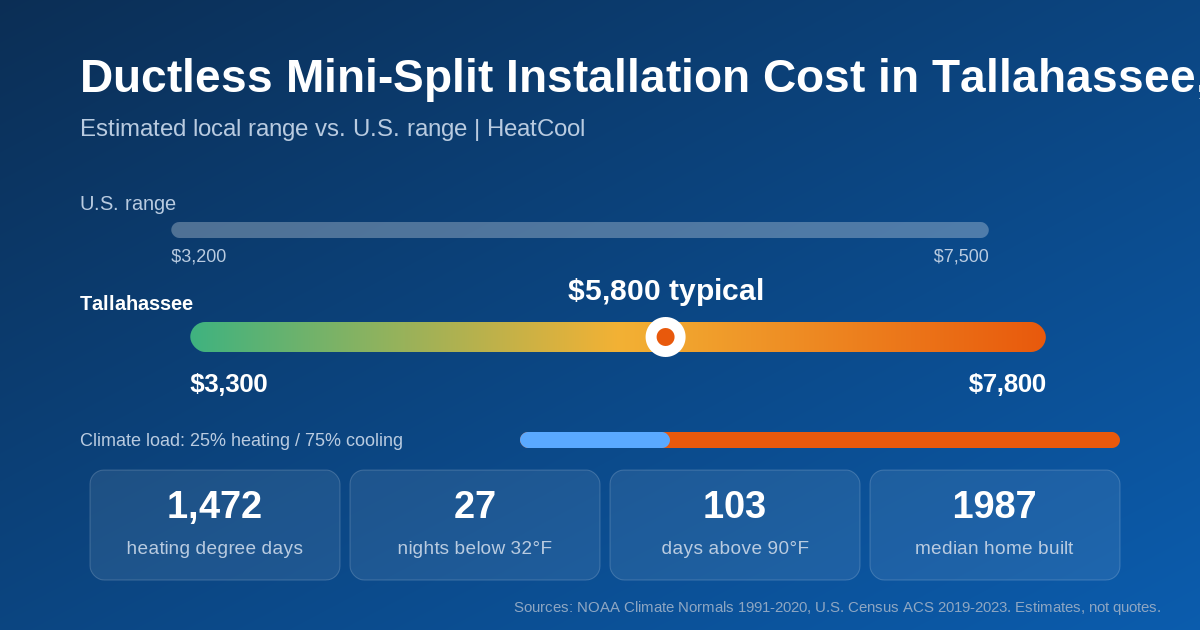
Ductless mini-split installation in Tallahassee runs about $5,800 for a typical job (single zone). Basic installs start near $3,300. High-efficiency equipment with duct or electrical work can reach $7,800.
Call (866) 332-0319 for Tallahassee Quotes
Tallahassee Weather and HVAC Load
In a normal year, Tallahassee racks up 1,472 heating and 2,758 cooling degree days (NOAA 1991-2020 normals). Cooling carries most of the load, which is why compressors and condenser fan motors wear out faster here than in northern cities. On average, Tallahassee gets 27 freezing nights and 103 days above 90°F per year. On the cooling side, a 2,000 sq ft house here usually needs around 3.5 tons. A tight, well-insulated house may get by with half a ton less.
| Heating degree days / year | 1,472 |
|---|---|
| Cooling degree days / year | 2,758 |
| Nights at or below 32°F | 27 |
| Days above 90°F | 103 |
| Average low / high | 57.2°F / 79.7°F |
Tallahassee Housing Stock
Census figures put the median build year in Tallahassee at 1987, so a typical house here has about 39 years on it. Plenty of houses from this period still run original 1990s or early-2000s equipment, which is past its expected service life. Tallahassee has roughly 33,000 owner-occupied homes, or 39.5% of households. With a median household income of $55,931 and a median home value of $276,000, local labor rates come out below the national middle in our model.
Leon County had 9 hail days and 69 days with damaging thunderstorm winds from 2020 through 2025, according to NOAA storm records. The largest hail reported was 2 inches across. Hail flattens the thin aluminum fins on condenser coils and cuts airflow. After a big storm, take a look at the outdoor unit; homeowners insurance often covers the damage. Leon County also had 9 tornado days in that period.
When It Makes Sense
- You're finishing a basement, attic or garage
- The house or addition has no ductwork
- You want to get rid of window units or baseboard heat
What Moves the Price
- A dedicated electrical circuit and disconnect
- A cold-climate model or a standard one
- Line set length and how many holes go through the wall
- BTU capacity for each zone
- How many zones (indoor heads) you need
For Tallahassee we raised the national figures about 4%, based on local income, home values and climate-based equipment sizing. Get at least three written quotes; real bids can land outside this range.
What the Quote Should Cover
- Electrical hookups
- The indoor head or heads and the outdoor unit
- Vacuum, refrigerant charge and startup
- Setting up the remote or thermostat
- Line set, line cover and condensate drain
Florida Permits, Efficiency Rules and Rebates
Florida is in the DOE's Southeast region, where new split central air conditioners need at least 14.3 SEER2 (13.8 SEER2 for systems of 45,000 BTU/h and up). Equipment replacements in Tallahassee generally need a mechanical permit, and a reputable contractor will pull it for you. Ask for their Florida license or registration number and a certificate of insurance with the quote. The federal 25C tax credit ended for equipment installed after December 31, 2025, so incentives now come mostly from utilities and state programs. Check your electric and gas utility's rebate page before you pick equipment.
Checking an HVAC Contractor's License in Florida
In Florida, HVAC contractors need a Class A or Class B air-conditioning contractor license from the Florida Construction Industry Licensing Board (DBPR). Ask every bidder in Tallahassee for the license number and look it up on the agency's website before you sign. Any technician who handles refrigerant must also hold EPA Section 608 certification.
Before You Hire in Tallahassee
- If winter nights regularly drop below 10°F, pay for a cold-climate model.
- Most mini-splits qualify for utility heat pump rebates, so check before you buy.
- Multi-zone systems cost more per room, but they run off a single outdoor unit.
- Check reviews on more than one site and ask how long the company has worked in your area.
Ductless Mini-Split Installation Questions from Tallahassee Homeowners
How much is ductless mini-split installation in Tallahassee?
Plan on $3,300 to $7,800, with most jobs near $5,800. Equipment efficiency, house size and the condition of the ducts and wiring decide where your quote falls.
When is the best time to schedule ductless mini-split installation in Tallahassee?
Between late fall and early spring. With 103 days over 90°F, Tallahassee contractors are booked solid all summer, and off-season jobs are easier to schedule and negotiate.
Do HVAC contractors need a license in Florida?
Yes. Florida requires a Class A or Class B air-conditioning contractor license from the Florida Construction Industry Licensing Board (DBPR). Ask for the license number and verify it on the agency's website.
How much does a multi-zone mini-split cost?
Installed, most multi-zone systems run $8,000 to $18,000, depending on the number of zones and the brand.
Can a mini-split heat a whole house?
In a smaller house or an open floor plan, yes. Bigger houses usually need several zones or a ducted heat pump.
Ductless Mini-Split Installation Near Tallahassee
- Cape Coral $4,000 to $9,400
- Fort Lauderdale $4,300 to $10,000
- Hialeah $3,700 to $8,800
- Pembroke Pines $4,200 to $9,900
- Port St. Lucie $4,000 to $9,400
- Hollywood $3,900 to $9,200
- St. Petersburg $3,900 to $9,200
- Gainesville $3,100 to $7,300
Sources: U.S. Census Bureau ACS 5-year estimates 2019-2023 and 2024 population estimates; NOAA NCEI U.S. Climate Normals 1991-2020, station Tallahassee; NOAA Storm Events Database 2020-2025, Leon County. Prices are our estimates, not contractor quotes. Updated 2026.